
Injury Time Markets: How Added Time Has Changed Betting Value After the 80th Minute
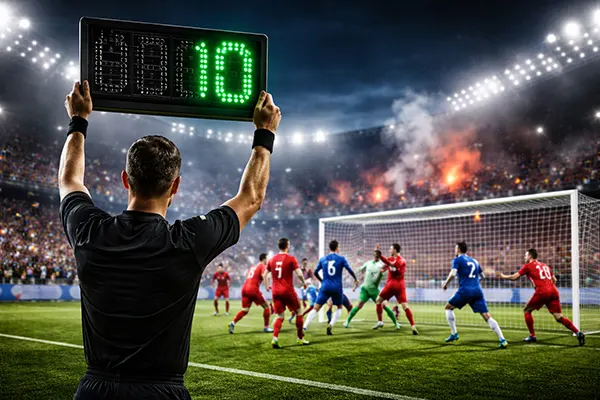
In recent years, injury time has shifted from being a marginal detail to a decisive factor in late-game betting. Changes in refereeing guidelines, VAR interventions, and stricter timekeeping have extended added minutes well beyond traditional expectations. For bettors focusing on markets after the 80th minute, this evolution has created both new opportunities and new risks that require a more analytical approach.
Why Added Time Has Increased Significantly in Modern Football
One of the key reasons behind longer injury time is the introduction of more accurate time tracking by referees. Governing bodies such as FIFA and UEFA have encouraged officials to account for every interruption, including substitutions, VAR checks, injuries, and time-wasting. As a result, matches that once featured 2–3 minutes of added time now regularly include 6–10 minutes or more.
VAR has played a central role in this shift. Each review can take between 30 seconds and several minutes, especially in complex situations involving offside lines or penalty decisions. These delays are now systematically added to the end of each half, significantly extending the effective playing time.
Another factor is the deliberate effort to discourage time-wasting. Referees are now instructed to compensate fully for delays caused by players, particularly in tight matches. This has transformed the final stages of games into longer and more intense periods, rather than brief closing moments.
How Longer Injury Time Affects Match Dynamics
Extended added time changes how teams approach the final minutes. Leading teams can no longer rely on simply “running down the clock,” as opponents have more time to create chances. This increases pressure and often leads to more attacking substitutions late in the match.
Trailing teams, on the other hand, benefit from additional opportunities to equalise or score decisive goals. Managers now plan late-game strategies with the expectation of extended play, often introducing fresh attackers specifically for injury time.
From a statistical perspective, the frequency of goals scored after the 85th minute has increased in several top leagues. This trend reinforces the importance of understanding how added time influences both team behaviour and overall scoring patterns.
Impact on Betting Markets After the 80th Minute
For bettors, the expansion of injury time has directly affected the value of late-game markets. Traditional assumptions about limited remaining time are no longer reliable, particularly in matches with frequent interruptions.
Markets such as “Next Goal,” “Over/Under Late Goals,” and “Both Teams to Score” in the final minutes have become more volatile. Odds that once reflected a narrow time window may now underestimate the true probability of additional goals.
Live betting platforms have adapted, but there are still inefficiencies. In fast-moving matches, odds may not fully adjust to the expected length of added time, creating potential value for those who can anticipate extended stoppage periods.
Key Markets Influenced by Extended Injury Time
The “Next Goal” market is particularly sensitive to added time. With an extra 6–10 minutes of play, the likelihood of a goal increases significantly compared to earlier models based on shorter stoppage periods.
Asian handicap lines in the final minutes also become more dynamic. A team leading by one goal may appear safe at the 88th minute, but extended injury time increases the probability of a late equaliser, affecting handicap outcomes.
Correct score markets are similarly impacted. Scores that seem stable late in the match are now more vulnerable, especially in games with high tempo or tactical urgency. Bettors must factor in the realistic duration of play rather than relying on the nominal 90-minute structure.

Practical Strategies for Betting on Injury Time Markets
To approach these markets effectively, bettors need to adjust their models and expectations. The first step is to monitor match context closely, including the number of stoppages, substitutions, and VAR interventions throughout the game.
Understanding referee tendencies can also provide an edge. Some officials consistently add more time than others, particularly in leagues where strict timekeeping is emphasised. Tracking these patterns over multiple matches can improve prediction accuracy.
Another important factor is team behaviour. Clubs known for late attacking pressure or strong bench depth are more likely to benefit from extended injury time, increasing the probability of late goals.
Common Mistakes and How to Avoid Them
A frequent mistake is underestimating the actual duration of play. Bettors often assume that a match will end shortly after the 90th minute, ignoring the possibility of extended added time that can exceed eight minutes.
Another error is relying solely on scoreline without considering momentum. A team trailing by one goal and dominating possession is far more likely to score during injury time than a team that is defending passively.
Finally, many overlook the psychological aspect. Late goals often result from increased risk-taking, defensive fatigue, and tactical shifts. Recognising these patterns can help identify value in markets that appear overpriced or underestimated.